EcoCastulum’s Contribution to OPTIMINER: Advancing Sustainable Phytomining and Life Cycle Assessment
By EcoCastulum
EcoCastulum, a technological partner in the OPTIMINER project, brings a multidisciplinary approach to the development of sustainable engineering solutions for the industrial and mining sectors.
Within the project, EcoCastulum leads the design and implementation of a sustainable and scalable phytomining solution, while also contributing to the development of a benchmarking framework to monitor and improve environmental and operational performance.
Through its activities in OPTIMINER, the company contributes to several key objectives:
Enhancing sustainability and resilience across mining operations
Improving resource efficiency in energy, water management, and waste valorisation
Definining strategies for toxicity management
Conducting full Life Cycle Analysis (LCA)
Ensuring financial sustainability through an AI-enabled Market Observatory system
Phytomining and PhytoremediatioN
EcoCastulum is exploring how plant-based strategies can contribute to a more sustainable approach to mining-impacted soils.
Phytoremediation and Phytomining offer an interesting perspective for the mining sector: plants can help stabilise contaminated soils and, in some cases, support the uptake and recovery of valuable metals from mining-affected materials.
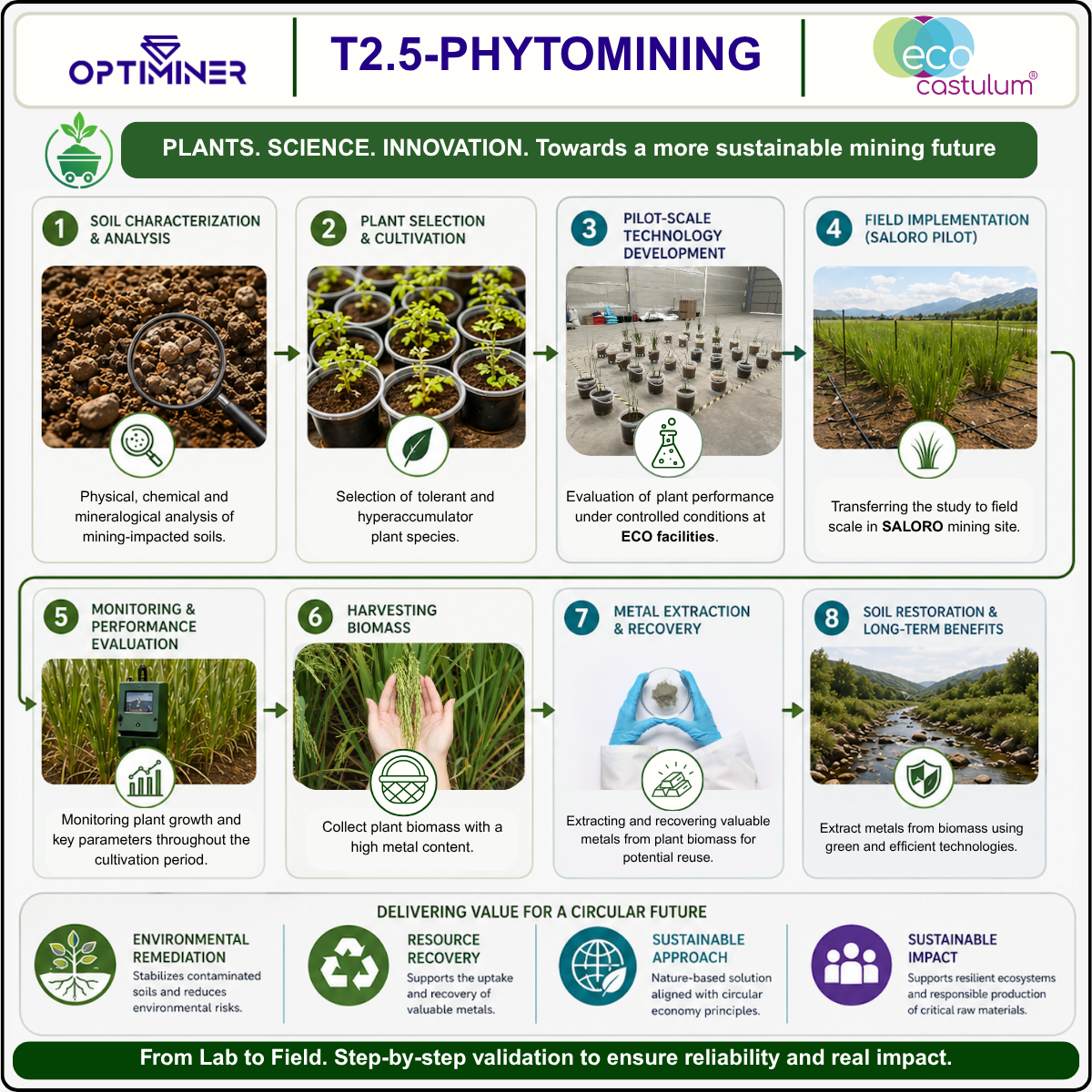
A key aspect of this approach is the role of hyperaccumulator plants and other tolerant species, which can grow under challenging conditions and contribute to environmental remediation, risk reduction and, under suitable conditions, resource recovery.
Their work is advancing in two complementary stages: first, through a pilot-scale implementation at EcoCastulum’s facilities, where we are currently monitoring plant development under controlled conditions; and later, with the plantation at SALORO, which will allow us to bring the study to field scale and assess its performance in a real mining environment.
This step-by-step approach is essential, because the success of these strategies depends on multiple factors, including plant establishment, biomass production, metal uptake, site conditions and agronomic management.
Beyond testing a scientific concept, the objective is to advance practical and scalable solutions that can contribute to more sustainable management of mining soils and residues.
Life Cycle Assessment (LCA)
Within OPTIMINER, life cycle assessment is not used merely as a reporting exercise, but as a practical tool to understand the environmental performance of the project’s pilot use cases and support better decision-making across the entire value chain.
LCA is applied as a continuous effort to systematically assess the environmental impacts of each use case, from extraction and processing to the final product or waste management, with the aim of identifying hotspots, quantifying emissions and waste, and determining the overall ecological footprint.
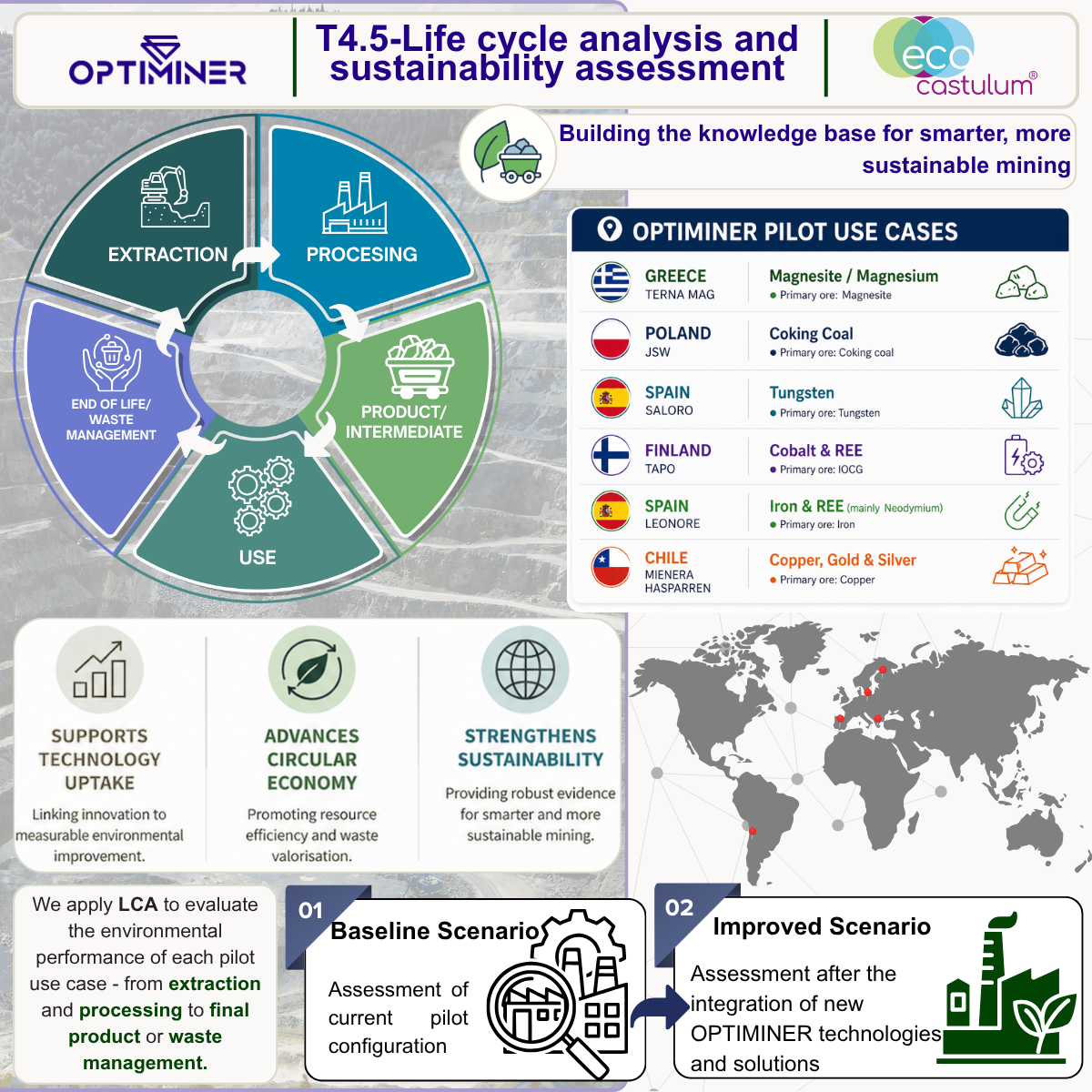
EcoCastulum works together with EUROCORE following a structured approach: first assessing the baseline scenario for each pilot, and then evaluating how the integration of OPTIMINER’s new technologies can modify that environmental profile. This makes it possible to compare current and improved process configurations on a consistent basis and to better understand where meaningful sustainability improvements can be achieved.
Across the six OPTIMINERuse cases in Spain, Greece, Poland, Finland and Chile, this perspective is especially valuable for linking technology uptake with stronger environmental insight in areas such as critical raw materials recovery, resource efficiency, waste valorisation and the circular economy.